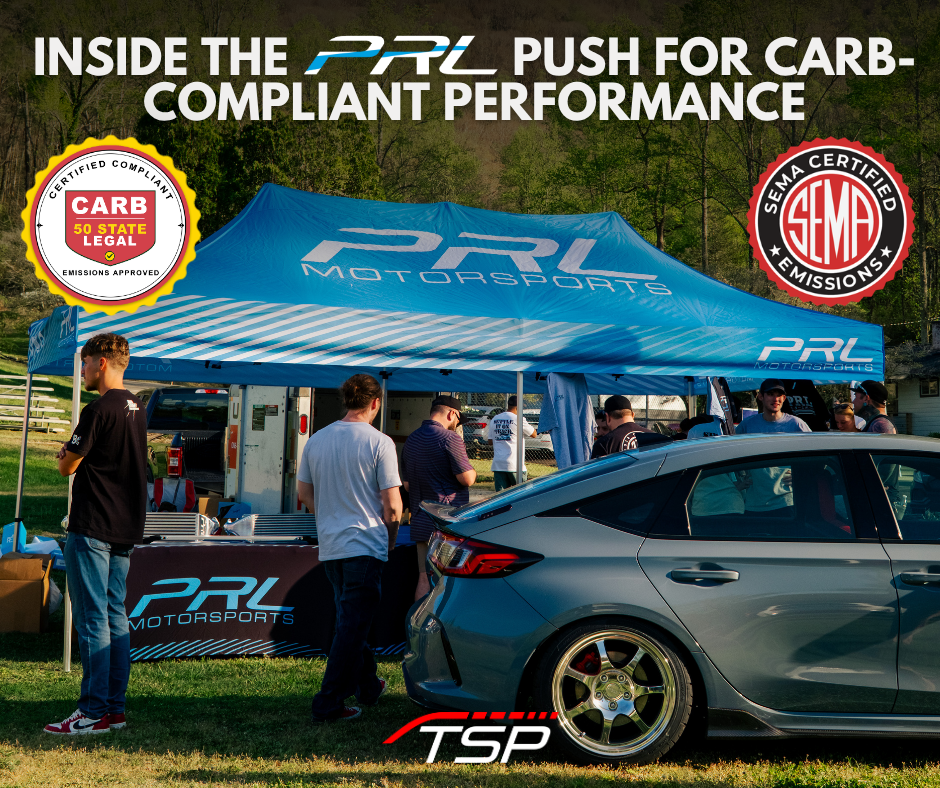
In an era when the EPA and California Air Resources Board (CARB) have made it clear they intend to enforce the Clean Air Act against the tuning industry, building emissions-legal performance parts is no longer a marketing checkbox — it is the price of staying in business. PRL Motorsports, the Export, Pennsylvania manufacturer best known for its Honda and Acura forced-induction hardware, has spent the past several years quietly retooling its catalog around that reality. The result is a growing portfolio of intakes, hoses, and tuning solutions that carry either a CARB Executive Order (EO) or SEMA Certified Emissions (SC-E) approval, with the company telegraphing that the rest of its catalog is headed in the same direction.
For Honda and Acura owners who have spent the last decade watching their favorite parts disappear from California-compliant shelves, that shift matters. It also matters to the broader specialty parts industry, which has been searching for a sustainable model under increasing federal and state scrutiny.

Who Is PRL Motorsports?
PRL Motorsports has been around longer than most of the platforms it now serves. The company traces its roots to fabrication and racing work in the late 1990s and early 2000s, was incorporated in 2007, and rebranded from PRL Racing to PRL Motorsports in 2011 as it expanded from trackside tuning into full-fledged product development. By 2021 the company had moved into a 25,000-square-foot facility in Export, Pennsylvania, and it now employs more than 25 engineers, fabricators, and support staff developing intercoolers, intake systems, turbocharger upgrades, downpipes, charge pipes, throttle body adapters, and flex-fuel kits.
Although the brand has touched Nissan, Mitsubishi, and Subaru platforms over the years, its current center of gravity is squarely on the modern Honda and Acura turbo lineup — the 1.5T Civic, Si, Accord, and CR-V; the 2.0T FK8 and FL5 Civic Type R; and the DE5 Acura Integra Type S. That focus is exactly where CARB enforcement and consumer demand for legality intersect most heavily.

Why CARB Compliance Matters in 2026
A CARB Executive Order is, in plain terms, a regulator-issued exemption confirming that an aftermarket part does not increase a vehicle’s emissions and may legally be installed on a pollution-controlled vehicle on public roads in all 50 states. Without one, a part may technically be a "race-only" item, and in California it cannot legally be sold for street use at all. SEMA’s newer SC-E (SEMA Certified Emissions) program, run through the SEMA Garage, offers a parallel path that confirms emissions compliance in 49 states — everywhere except California, where only a CARB EO will do.
The pressure to obtain those approvals is not theoretical. After CARB’s 2020 enforcement advisory and a series of high-profile EPA settlements with tuners and parts makers, the industry got the message: certify or shrink. Getting a CARB EO is expensive and slow, often involving months of dyno work, drive-cycle testing, and OBD-II compatibility validation. For a small-to-mid-size manufacturer, choosing which products to push through that gauntlet is a strategic decision with real financial weight. The fact that PRL has been willing to spend that money repeatedly, on multiple platforms, says something about where the company sees the future of the aftermarket.
Inside the SEMA Garage Partnership
Most of PRL’s recent compliance work has run through the SEMA Garage in Plymouth, Michigan — the industry-funded test facility designed specifically to make CARB and EPA testing accessible to specialty parts manufacturers. According to PRL’s own published updates, the SEMA Garage handles the chassis-dyno emissions testing, drive-cycle validation, and OBD readiness checks required to demonstrate that a product does not adversely affect a vehicle’s emissions or diagnostics systems.
PRL has used the facility to test entire FL5 Civic Type R vehicles, with photos of its development cars on the dyno circulating through Honda enthusiast media. The company has also publicly described its internal process — baseline runs, modified runs, OBD scans, and repeated cycles — as evidence that the parts going to market are not just legally compliant on paper but engineered with emissions in mind from the start. That framing, true or marketing-tinged, is at least the right framing for an industry that spent decades treating emissions hardware as something to delete first and explain later.

What’s Actually Certified: A Platform-by-Platform Breakdown
The clearest way to understand where PRL has invested is to look at the products that have actually crossed the finish line, organized by chassis. The list below covers parts that, as of this writing, carry either a CARB EO (50-state legal) or SEMA SC-E approval (49-state legal).
2023+ Honda Civic Type R / 2024+ Acura Integra Type S
This is PRL’s flagship CARB program and the platform where the company has invested most visibly. The FL5/DE5 High Volume Intake System — a 6-inch cone filter feeding an HDPE rotomolded airbox with a secondary inlet duct — is approved under CARB EO D-878-8, making it 50-state legal with no ECU calibration required. The matte and gloss carbon-fiber variants of the high-volume intake have received SEMA SC-E approval, as has the Silicone Intake Hose Kit. PRL also lists a Stage 1 Intake System for the platform that falls under the same EO D-878-8 umbrella.
2017-2021 Honda Civic Type R
The previous-generation Type R platform is also covered under EO D-878-8 for the High Volume Intake System, Titanium or Carbon Fiber Turbocharger Inlet Pipe, and the Stage 1 Intake. PRL’s FK8 design uses a 6-inch cone filter and a two-piece MAF housing with velocity stacks; the standard-bore version is approved with no calibration required, while the big-bore MAF variant remains a tuning-required, race-oriented option. Notably, the FK8 Billet Intercooler Upgrade also carries a CARB EO under the D-878 family — a bigger deal than it sounds, because intercoolers historically have been treated as race-only hardware. Having a 50-state-legal billet core for the FK8 is one of the more significant compliance wins on the platform.
2022+ Honda Civic 1.5T / 2.0L NA & 2023+ Acura Integra 1.5T
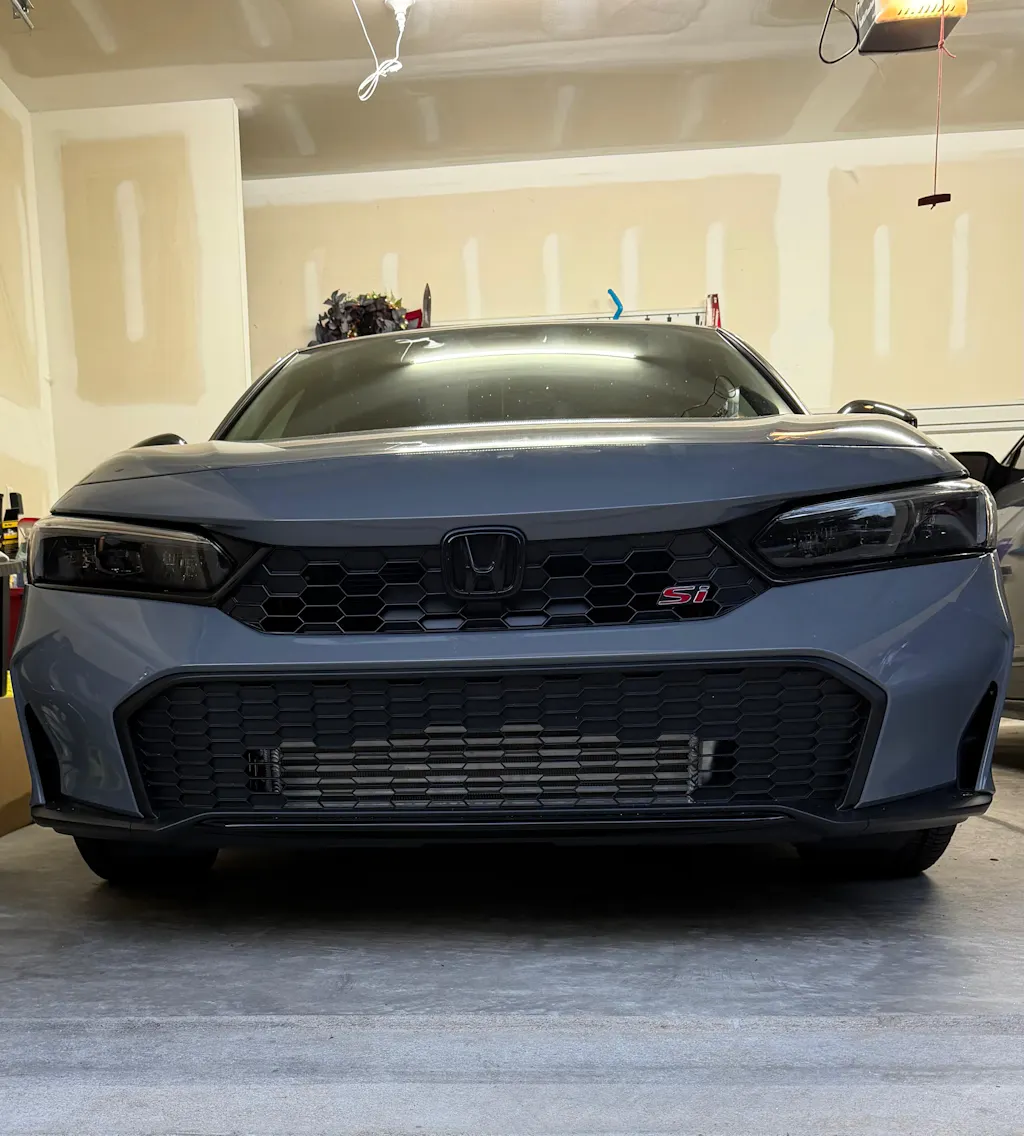
PRL offers high-volume intake systems for both the 11th-gen 1.5T and 2.0L naturally aspirated Civic. The 2022+ Civic 1.5T platform is also tied to CARB-compliant tuning through the Hondata FlashPro for 2022+ Civic 1.5T, which carries CARB EO D-742-1 — a notable piece of the puzzle because legal hardware paired with non-legal software is a common compliance gap PRL’s ecosystem closes here. On top of that, the 2022-2026 Civic 1.5T and 2023-2026 Acura Integra 1.5T share a Turbocharger Inlet Pipe and a Billet Intercooler Upgrade, both of which carry SEMA SC-E approval (the intercooler under SC-APG01-0054). That puts a turbo-side hardware upgrade and a charge-cooling upgrade on the legal table for the 1.5T crowd, which is exactly the part of the build path that traditionally pushed owners off-road or off-California.
2017-2020 Honda Civic Si
The PRL Cobra Cold Air Intake System for the 2017-2021 Civic Si 1.5T was one of the company’s earlier wins, approved under CARB EO D-878-5. For Si owners in California — a sizable share of that market — the EO’d intake has been one of the few legitimate bolt-on options on the shelf for years.
2016-2021 Honda Civic 1.5T (Non-Si)
In early 2026, PRL added the 2016-2021 Honda Civic 1.5T (Non-Si) Cold Air Intake System — Standard Bore to its CARB-approved roster. It is a small detail with outsized meaning: the non-Si 1.5T crowd has historically been an afterthought in the aftermarket, and a legal intake here suggests PRL is willing to spend certification dollars on volume parts, not just halo cars. The 2016-2021 Civic 1.5T Billet Intercooler Upgrade is also CARB-certified under the D-878 family, giving 10th-gen 1.5T owners a 50-state-legal charge-cooling upgrade in addition to the intake — a rare combo at this price point on this platform.
2016-2021 Honda Civic 2.0L NA
The naturally-aspirated 10th-gen Civic is the platform most often left out of the conversation, but PRL has not skipped it. The 2016-2021 Civic 2.0L High Volume Intake System carries a SEMA Certified Emissions (SC-E) number, under SC-APG01-0045, making it 49-state legal when installed per PRL’s application guide. The design uses a 4-inch oiled cone filter, a one-piece high-volume MAF housing, and an HDPE rotomolded airbox that mates to the factory air guide and seal — the same compliance-minded engineering approach PRL has applied to its turbo platforms, just adapted for the N/A crowd. There is no CARB EO on this part as of this writing, so California owners are still on the sidelines, but everyone else is covered.
2018-2022 Honda Accord 1.5T & 2.0T
Often overlooked in Civic-heavy coverage, the 10th-gen Accord shares its turbocharged powertrains with much of PRL’s Civic catalog and gets its own compliance story. The 2018-2022 Honda Accord 1.5T and 2.0T Billet Intercooler Upgrade is CARB-certified under the D-878 family, making it a 50-state-legal upgrade for both the entry-level 1.5T sedan and the more aggressive 2.0T. Accord owners chasing legal performance have historically had thin pickings; a CARB-EO billet intercooler is a meaningful step toward changing that.

Where the Program Is Headed
PRL has been transparent that compliance work is ongoing rather than complete. The company’s 2025 emissions update explicitly framed CARB and SC-E approval as a long-term commitment, with packaging and documentation now including EO numbers so customers can prove legality at registration, smog, or dealer service. PRL has also signaled additional FL5/DE5 products and 11th-gen Civic parts queued up for testing.
Two things will be worth watching. First, whether PRL keeps pushing the program past intakes and into the harder categories. Billet intercoolers across the FK8, 10th-gen Civic 1.5T, 10th-gen Accord, and 11th-gen Civic/Integra platforms — plus a SEMA-certified turbocharger inlet pipe on the 11th-gen 1.5T cars — already put PRL ahead of most competitors on charge-air and forced-induction-side compliance. The next obvious frontier is downpipes and turbocharger upgrades, where the regulatory bar is highest and an EO would be a genuine industry milestone. Second, whether the company’s investment translates into competitive pressure on rivals: when one major player spends the money to certify, customers in California start asking the others why they haven’t.
The Bigger Picture
There is a fair argument that the emissions-compliant performance market is the only performance market with a future, and PRL’s posture suggests they have read the same chart everyone else has. The cynical read is that this is a marketing exercise and a way to keep selling into California. The more generous read is that PRL is doing the unglamorous engineering work — dyno cycles, OBD scans, paperwork — that the tuning industry has historically resisted, and is doing it in public.
Both can be true. What is harder to dispute is that for an FK8, FL5, DE5, Accord, or 1.5T Civic/Integra owner who wants to modify a car they actually drive on the street, the list of legal options has gotten meaningfully longer because PRL has chosen to invest in it. That is a real outcome, regardless of motive, and it is the kind of outcome the industry will need a lot more of if street-legal speed is going to remain street-legal.

Two Step Performance was founded in 2017, preceded by a lifelong passion for modifying and driving turbocharged imports. We began with a small assortment of handpicked brands that we have personally used and believed in. As the company and the community around us have grown, we have continued to add carefully selected product lines to our catalog. In addition to offering brands that you already know and trust, one of our favorite things to do is to identify innovative new products and emerging brands and add them to our catalog as well. We only sell products that we believe in. We also take great pride in offering the best experience to our customers every step of the way. If we can help answer questions on your next build, give us a shout on our contact page.